
Rediscovering the Sacred: Towards a Conscious and Sacred Space, Beyond Religion

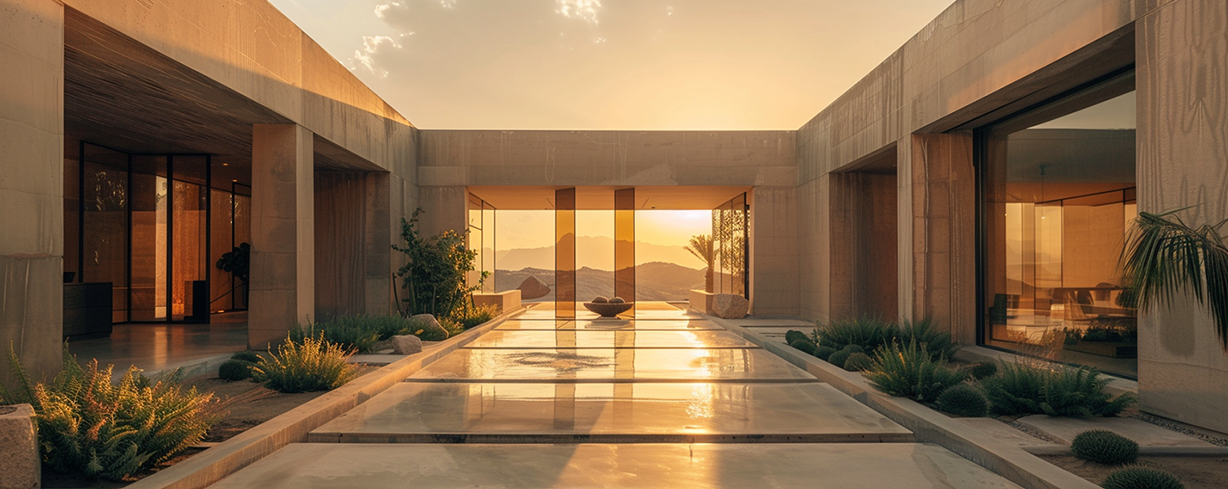
‘Sacredness’ in the 21st century is synonymous with connection, intention, presence, union, and alignment with the harmonious rhythm of the cosmos. It is not something religious, but a fundamental human need to combat the emptiness of modern society and the modern human being.
The Hunger of Modern Humanity
The modern human lives in a mental world, where their creations are completely disconnected from reality, from nature, from the here and now, from their primordial essence.
They live in an illusory world where past experiences and projections toward the future reign. This total disconnection is the root of modern ailments—the sensation of emptiness (despite living in abundance), chronic stress, and the entire series of mental (and therefore emotional) imbalances that modern humans face are precisely what distances them more and more from their true nature.
What if the cure were not ‘out there’, but ‘in here’, in the space we inhabit each day? Even more so, within your own Being, in the secret cave of your heart.
Sacredness Is Not Religion—What Is 'Sacred'?
Although the sacred has always been associated with the religious or spiritual, it is both curious and beautiful to see that its etymology leads you not to any monotheistic cult, but to reconnection with yourself. Sacred comes from the word ‘Sacer’, and its root meaning has nothing to do with ‘God’, but rather ‘separated from the common, set apart, inviolable’—therefore, to separate, to consecrate an experience.
On the other hand, religion comes from the Latin ‘Religio’, and although its etymology is debated, it has two possible roots: religare—’to bind again, to reconnect’—implying a bond between humanity and God through a pact or dogma. Or relegere—’to reread, to gather oneself’—implying a scrupulous observance of rites. In both cases, it describes a system, a structure, a set of practices to bind you to a system.
Therefore, I take the liberty of freeing the word sacred from the religious, and this is where we can restore its primordial value, finding its roots in the dharmic traditions of Hinduism (Sanatana Dharma) and in pagan traditions across both Europe and the Americas
The Soul of Place: Listening to the Genius Loci
For millennia, human beings have sought to connect with a more sacred reality through architecture. In 10,000 BCE, Indian culture, in one of its many sacred texts—the Vastu Shastra—already spoke of how to create spaces that would elevate humanity to its deepest reality.
Closer to home, European pagan traditions such as the Celts, with their dolmens, menhirs, and stone circles like those at Stonehenge—these are not ‘churches’; they are astronomical markers, acupuncture points on the earth, places where the energy of sky and earth meet. They are pure sacred architecture without the imposition of religious dogma.
In the Norse tradition, we see this in the concept of Yggdrasil, the world tree that connects all realms. It is a powerful cosmological metaphor for understanding the connection between the ‘below’ (the roots, the foundations), the ‘middle’ (the trunk, the habitable space), and the ‘above’ (the branches, the sky, inspiration).
The Genius Loci—this Roman concept referring to the ‘guardian spirit of a place’. In the Slavic tradition, the domovik or domovoi, the protective spirit of the home. We see this equally in Hinduism (Sanatana Dharma) as yakshas, and this same concept appears in pagan traditions around the world. The idea that a soul or spirit governs and protects zones, villages, homes, groups of animals and plants; that divinity exists in the air, in fire, in water—this allows you to sacralise the creations of the earth; your entire life becomes sacred. A concept completely contrary to monotheism, in which only a single god is sacred.
Every place has its own essence, its unique character. A good architect does not impose a soulless structure upon a place, but rather dialogues with its genius loci, listens to it, and gives it built form. This stands in contrast to generic, standardised architecture disconnected from the primordial values of the human being.
Building the Temple: The Principles of Sacred Design
The architects and philosophers of the past built, understood reality, and created by following these natural rules charged with coherence, rhythm, and sacredness—leading human beings to connect with something that went beyond everyday experience, and above all, seeking to elevate the human being. Inviting them, through built space, to find that transcendental silence that unites them with the divine (the cosmos).
From the divine proportion (golden section) of Pythagorean geometry, where mathematical rules interweave with mystical and esoteric nature. Passing through ‘living in a coherent, alive, and profoundly human space’ of C. Alexander, the order and light of Kahn, to the creation of a sensory experience that anchors us in the present of Pallasmaa and Zumthor (to cite but a few). This demonstrates that human beings have always longed for that union with the divine, seeking that sacredness in the forms that surround us.
Your Home, Your Centre of the World
Through conscious design, any space can become that ‘central axis’, that sacred anchor point amid the chaos of the profane world—that ‘hierophany’ of Eliade. I invite you to see your own home not merely as a shelter, but as an active tool for personal transformation. Sacralising not only the space you inhabit but also your life itself. Recognising that you are part of a universal rhythm that pulses and vibrates in harmony with everything and everyone.
Dr. Natalia Botero
Architect specialising in Vastu Shastra, Neuroarchitecture, and Biophilic Design www.espaciosparaser.com
Does your home support your wellbeing? → Let’s talk about your space
