
How spatial design affects your rest (science + Vastu)

More than 23% of working adults meet diagnostic criteria for insomnia. Not due to lack of discipline or stress management (most have already tried melatonin, cognitive therapy or meditation apps) (Kessler et al., Sleep, 2011).
What no one has told them is that the problem may not be in their physiology. It may be in their bedroom.
A window without blackout curtains triggering waking at 6:15am even though the alarm is set for 7:30. 6,500K LEDs on until 11pm suppressing melatonin as if it were midday. A bed aligned directly between the door and the window keeping the brain in a state of subtle but constant alertness.
Your bedroom may be designed, without intending to, to keep you awake.
Insomnia has a cost that goes beyond fatigue: each person with chronic insomnia loses the equivalent of 45 to 54 days of productivity per year, with an estimated economic impact of more than $200 billion annually in the United States alone (RAND Corporation, 2023). For executives and high-performance professionals, that cost multiplies.
Your bedroom is not neutral. It is a chemical laboratory that produces (or blocks) melatonin, cortisol and serotonin every night. In the following pages you will discover why your space may be sabotaging your rest without you knowing it, and what you can do to reverse it.
From sleep science to a brain in rest mode
To understand how space affects your rest, you first need to understand how your brain processes deep rest at a more biological level. Sleep is not a passive state — it is an active maintenance operation of the nervous system. To reach the deep sleep phase, or N3 phase of NREM sleep, the brain must first go through the two preceding phases: N1 (drowsiness) and N2 (light sleep). Deep sleep is the most restorative stage of rest, characterised by slow brain waves (delta waves), low heart rate and respiratory rate, and total muscle relaxation. It is essential for physical recovery, memory consolidation and the elimination of brain toxins. To reach this phase (regulated by your nervous system) three biological pillars must be met, and your space, if well designed, will support them or sabotage them.
1. Circadian rhythms: The internal clock that space regulates
The suprachiasmatic nucleus (SCN), a small brain structure the size of a grain of rice, directs the 24-hour sleep-wake cycle. Its primary synchroniser is light. Natural-spectrum blue light in the morning: suppresses melatonin, activates cortisol, wakes you up. Darkness at night: activates melatonin, lowers body temperature, induces sleep.
The modern problem is constant artificial light. Your brain cannot distinguish between sunlight at 10:00am and a 6,500K LED at 10:00pm. Both send the same signal: “It’s daytime. Activate.”
Gooley et al. (2011) demonstrated that exposure to room light before sleep suppresses melatonin by up to 80% and shifts the circadian rhythm by 1.5 to 3 hours. Reading on a tablet at 10:00pm is biologically equivalent to your brain believing it is 1:00pm.
2. Melatonin: The hormone your space can silence
The pineal gland begins producing melatonin around 9:00pm if there is sufficient darkness. It reaches its peak between 2:00am and 4:00am. This is the chemical signal that induces sleep and regulates nocturnal cellular repair.
What blocks it is not only the phone screen. It is the bathroom LED you turn on at 3:00am. The streetlight coming through the gap in the blind. The red standby light of the television. Ambient temperature above 21°C. The phone screen left on, the laptop charger cables left charging overnight, the router lights you never switch off before bed. Cajochen et al. (2005) demonstrated that just 2 hours of nocturnal blue light suppresses 50% of melatonin production.
3. Cortisol: The accelerator that visual clutter keeps switched on
Cortisol follows the opposite cycle: higher in the morning to activate you, and lower in the early hours to allow repair during sleep. But if your bedroom is constantly emitting activation signals (blue light, visual clutter, saturated colours, mirrors reflecting lights and movement) cortisol remains elevated even at 11:00pm.
Trying to sleep with elevated cortisol is like trying to meditate while a fire alarm is going off. Your biology receives contradictory instructions, the alert state activates continuously, and if this repeats daily, it becomes chronic insomnia.
These are the 6 most common situations in your bedroom that prevent you from falling asleep
1. Nocturnal blue light:
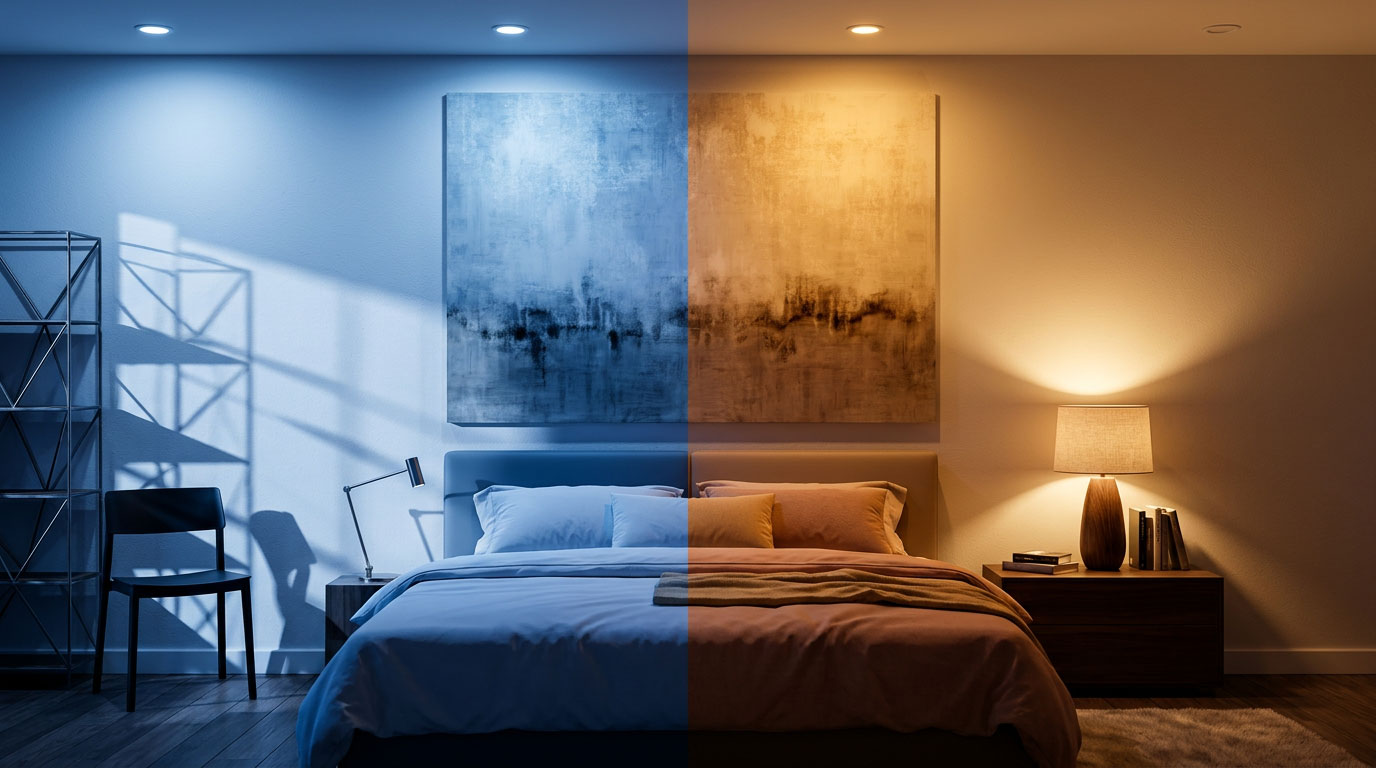
Do you use 5,000–6,500K LED lights in your room and leave them on after 8:00pm, along with screens, digital clocks, or streetlight coming in without blackout curtains? Every source of blue light left on during the night tells your brain: “it’s not time to sleep yet.”
The solution is a gradual transition: moving from neutral light (3,500K) to warm light (2,700K) to amber light (1,800K) as the night progresses. If your room looks as bright as an office at 10:00pm, your brain thinks you are in the office.
2. Disruptive magnetic orientation
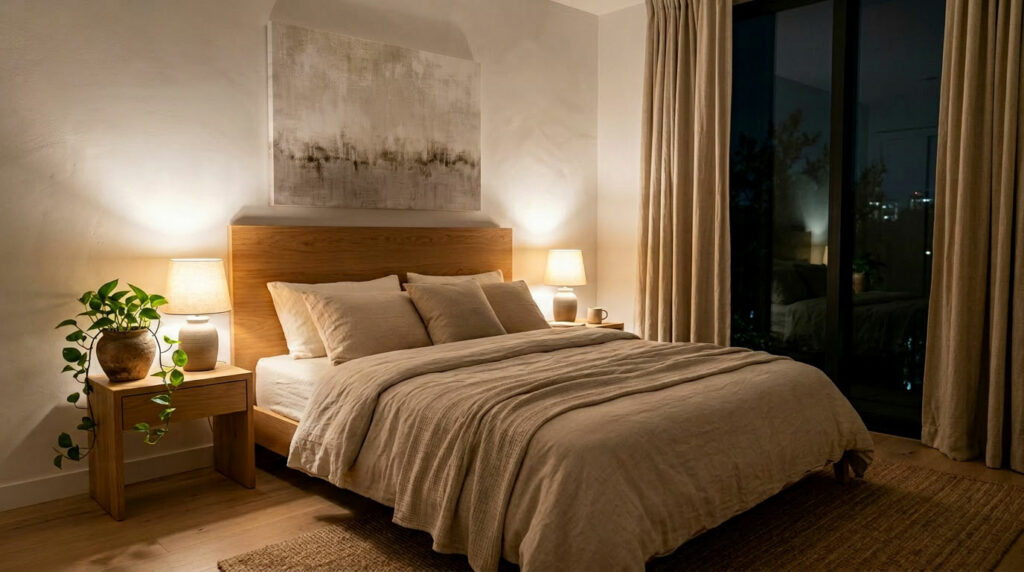
Vastu Shastra, this millennia-old science of the Vedas, has prescribed for more than 5,000 years that to achieve restorative rest, the head should point south during sleep. Scientific validation came much later: Colzato et al. (2017) documented that north-south alignment during sleep improves interhemispheric coherence in EEG testing.
The Earth’s magnetic field has a subtle but real effect on sleep architecture. Sleeping with the head pointing north creates a magnetic friction that fragments rest without you being aware of it.
3. Door-window cross current
When your bed is aligned directly between the door and the window, the reptilian brain (the brainstem that monitors the environment even while you sleep) perceives a zone of passage and transit, activating the sympathetic nervous system in a subtle but constant way. This prevents you from reaching the N3 deep sleep phase.
Keeping the bed out of that direct current allows the autonomic nervous system to shift into calm mode (parasympathetic): the state from which the body repairs itself and reaches deep sleep.
4. Synthetic materials
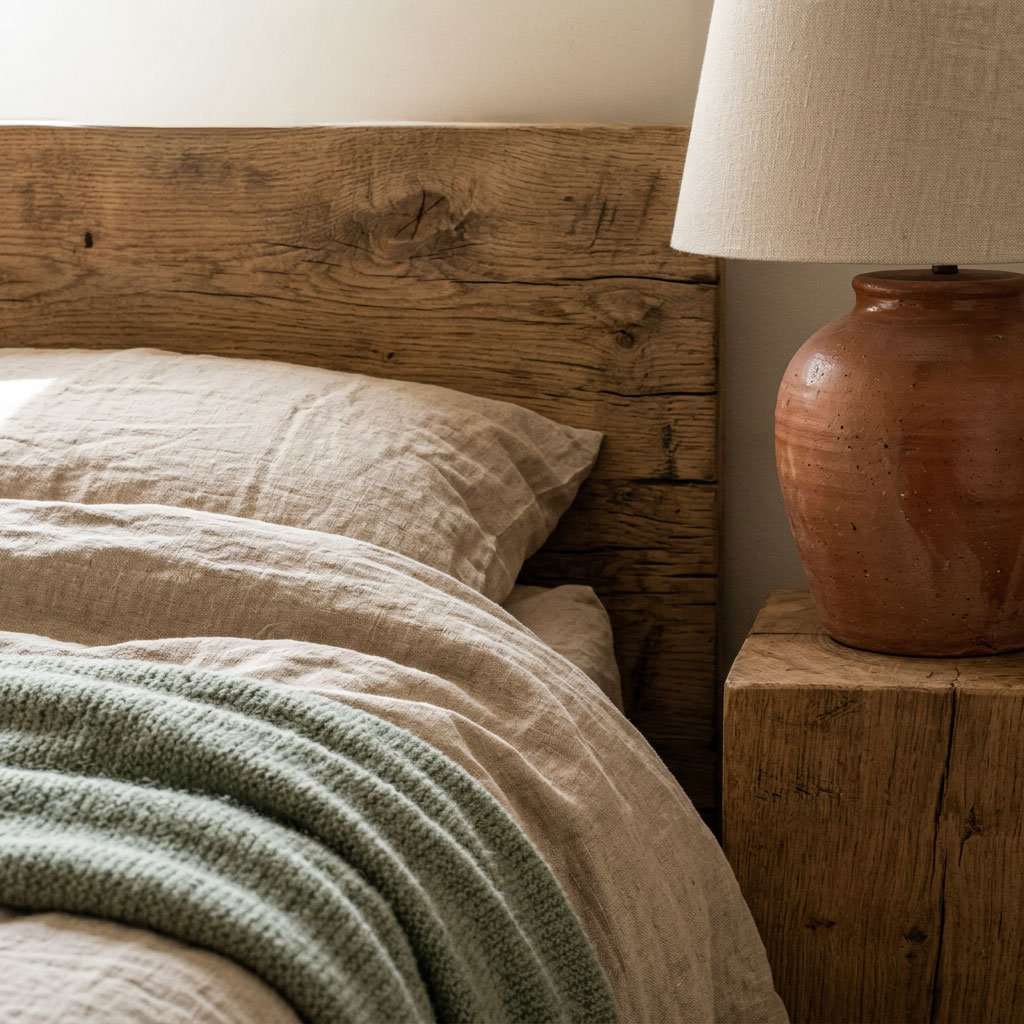
Your skin is the largest organ in the body and processes textures continuously, even during sleep. The human brain evolved in contact with wood, stone and natural fibres. Synthetic materials (laminates, polyester, plastic) are not recognised as “safe” by the evolutionary nervous system.
Tsunetsugu et al. (2007) demonstrated that visual contact with wood reduces salivary cortisol by 13%. Kelz et al. (2011) documented a reduction of 6 beats per minute in patients’ heart rate when in natural wood environments. The quality of your sleep is reflected in how you design your space.
5. Visual clutter and frontal mirror
Visual clutter activates the anterior cingulate cortex (the same brain region that processes physical pain and acts as a mediator of your emotions). It must deactivate or calm down during sleep; if it does not, the brain keeps monitoring conflicts. Every misplaced object is a stimulus the brain registers, even during sleep. A mirror facing the bed continuously reflects movement and light, activating peripheral vision in alert mode. Your sleep will be constantly fragmented.
In Vastu, the mirror is Rajas (energy of activity and movement). Whereas rest requires a degree of Tamas: stillness.
6. Wrong colour temperature
If your bedroom walls are pure white and you have textiles in grey, blue or cold tones, these communicate alertness, not rest.
There is also an important dissociation that very few people know about: the difference between the ideal ambient temperature for sleep and the visual colour temperature. While the ideal ambient temperature should be cool (17–19°C), the visual colour temperature should be warm.
Therefore the use of colours such as beige, sand, soft terracotta, sage green and natural wood is recommended. Dazkir and Read (2012) confirmed that warm colours generate relaxation and cool colours generate alertness in the perception of the environment.
Vastu for the bedroom: Ancestral wisdom validated
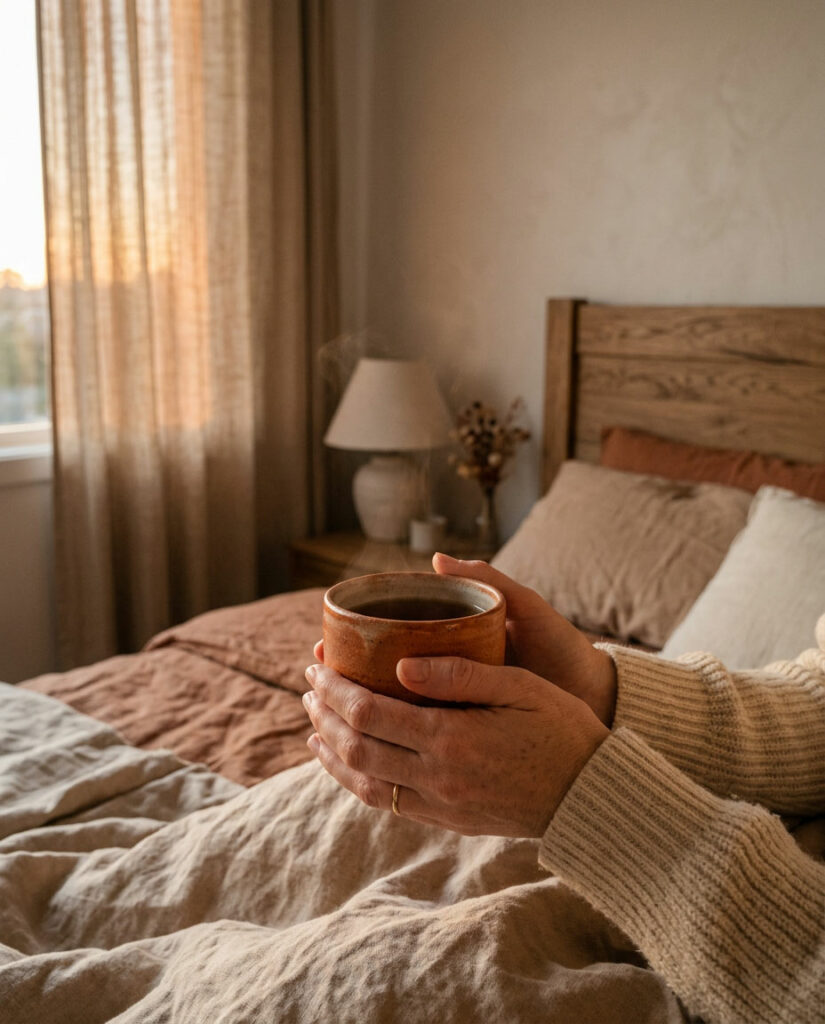
Vastu Shastra did not conceive the bedroom merely as a space for sleeping. The sages of Vastu called it the Garbhagriha (the sanctum sanctorum) — the most sacred space in the home. Not for religious reasons, but for functional ones: sleep is the state of maximum vulnerability of the human being, and therefore requires the most protected and aligned environment.
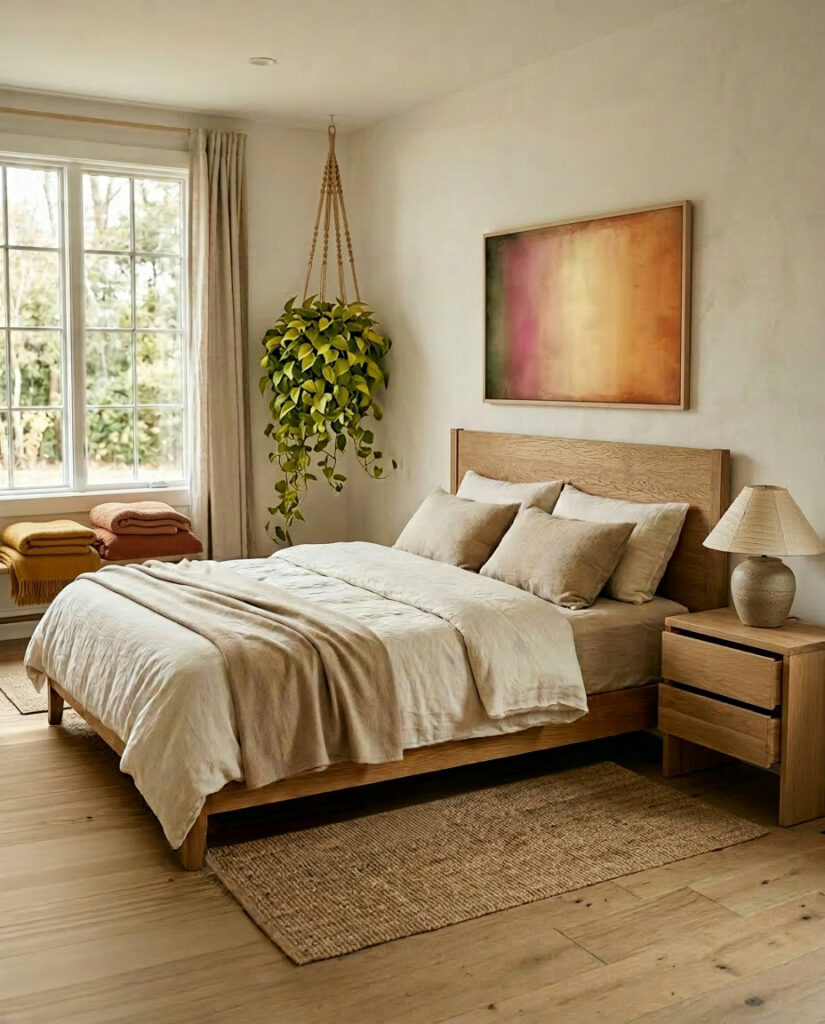
Five Vastu principles for the bedroom that today have direct scientific validation:
1. Location in the southwest of the home. The southwest receives less direct morning sunlight, which favours the natural production of nocturnal melatonin and prevents premature waking caused by dawn light. Lockley et al. (2006) documented that exposure to morning light advances the circadian rhythm (the opposite effect to what you need if you want to sleep until 7:30am).
2. Head oriented south (second option: east). Alignment with the Earth’s magnetic flow. Interhemispheric coherence in EEG results improves with this orientation (Colzato et al., 2017). Avoid head pointing north or west.
3. Headboard against a solid wall, out of the direct door-window current. Activation of the parasympathetic system = restorative rest. The Vedic tradition adds: the feet should not point towards the door (a position symbolically associated with death, which the nervous system unconsciously registers as a threat).
4. The five elements balanced (Pancha Mahabhuta). Earth: solid, natural materials. Fire: keep to a minimum, reduce electronic devices, whose electromagnetic fields alter melatonin production (Burch et al., 1999). Water: avoid fountains or aquariums in the bedroom, as they generate activating energy. Air: gentle ventilation, without direct draughts. Ether: empty space free of furniture or obstacles (minimalism is not aesthetics, it is biological function).
5. Harmonic proportions. Bedrooms should follow square or rectangular forms in ratios of approximately 1:2. Medium ceiling heights favour the internalisation that precedes deep sleep. Vartanian et al. (2013) documented that high ceilings activate abstract thinking (the opposite of the disconnection we need during rest).
Guide to applying neuroarchitecture in your bedroom
Diagnosis is the first step. Intervention, the second.
Step 1: Bedroom audit
Before buying anything, assess your current situation with this checklist:
- Bed orientation? (Head pointing north = priority problem)
- Door-window cross current? (Bed on that line = problem)
- Blue light active after 8:00pm? (Cool LEDs, screens, streetlights = problem)
- Synthetic materials above 60%? (Laminates, polyester, plastic = problem)
- Visual clutter or mirror facing the bed? (Problem)
- Colour temperature: pure white, greys, blues? (Problem)
Step 2: Interventions by investment level
Quick wins (0–200€): Reorient the bed to face south. Remove screens from the bedroom. Cover front-facing mirrors at night with a dark cloth. Replace bulbs with dimmable 2,700K. Clear and declutter surfaces.
Mid-range interventions (200–1,000€): Blackout curtains. Natural textiles (linen sheets, merino wool blanket, jute or wool rug) Earth-tone paint. A sansevieria or pothos (release oxygen at night).
Renovation interventions (1,000€+): Solid wood headboard. Natural parquet flooring. Automated circadian lighting system. Optimisation of window orientation.
Step 3: Measurement
At 4 weeks, evaluate: time taken to fall asleep (target: under 20 minutes), nocturnal wake-ups (target: 0–1), natural waking without an alarm, subjective sense of rest (target: 8+/10).
The most common pattern: When the bedroom works against you
In the spaces and bedrooms I analyse, the problem is rarely a single factor. What is common is a combination of several elements that, on their own, already have a measurable impact on sleep quality (and together, create an environment designed to obstruct deep rest).
The patterns I find most frequently are: sleeping with the head oriented north, the bed positioned directly in the door-window current, exterior light entering without blackout curtains, nocturnal blue light sources (digital clocks, device standbys) near the bed, mirrors in the room facing the bed, and accumulated visual clutter.
The diagnosis I carry out is not medical (it is spatial). But it is not generic either: the same poorly arranged bedroom affects people with different constitutions in different ways. In advanced Vastu, we use the natal chart (Jyotisha) not as a predictive reading (but as a map that defines the person’s constitution). The planetary dominances at the moment of birth capture patterns of physiological response, nervous system activation thresholds and sensory sensitivities that vary from person to person. What Vastu prescribes as a universal principle, Jyotisha calibrates to the individual. Two people in the same poorly arranged bedroom sleep differently (and therefore need different interventions).
The intervention does not require a full renovation: most significant changes are implemented within two weeks, with a considered investment, reorienting the bed, adjusting the lighting, eliminating nocturnal visual stimuli, and defining the colour, material and texture patterns that adapt to the constitution of the person or people inhabiting that space.
The parameters I typically measure at six weeks are: the time it takes a person to fall asleep (clinical target: under 20 minutes), number of nocturnal wake-ups (target: 0–1), subjective quality of rest, and where applicable, whether the inhabitant decides to reduce their reliance on external sleep aids.
Your bedroom as preventive medicine
Sleep is not a luxury. It is the most important maintenance process your nervous system carries out every 24 hours. And the space where that process happens matters more than anyone has told you.
We spend 10,000€ on a state-of-the-art viscoelastic mattress. But we keep sleeping under 6,500K LEDs, with the head oriented north and the bed in direct current between the door and the window.
The mattress is 10% of the equation. The space is the 90%.
Optimising your bedroom is not decoration. It is applied biology. The cost of not doing it is measured in reduced cognitive performance, increased cardiovascular risk, diabetes, depression and long-term cognitive decline. The cost of doing it: between 500€ and 2,000€ of intelligent intervention.
How much will it cost you not to sleep deeply every night for the next 30 years?
Would you like me to analyse your space?
If you have been sleeping enough hours but still not truly resting, the problem may be in your space — not your physiology.
Vastu Alignment Analysis This is the entry point to the complete diagnosis. It includes analysis of the entire home — not just the bedroom — incorporating the individual constitution profile (Jyotisha) as a layer of personal precision. The result is a PDF report with specific remedies for your space and your constitution, plus a 90-minute video call to work through it together. It does not include design or renders. It is diagnosis and roadmap — the first step to understanding what is failing and why. Investment from 450€
Wellness Design Blueprint. Applicable to existing homes and new builds alike. This is the level of complete intervention. I do not only diagnose what is failing — I design the solution. You receive visualisations of the transformed space, technical drawings, exact specification of materials, lighting, biophilia and neuroarchitecture applied to your project, and accompaniment throughout the implementation. The result is an executable project, not a list of changes. It integrates neuroarchitecture, biophilia, Vastu Shastra and individual constitution profile into a single 20–25 page dossier designed for your specific space. Investment from 1,500€
Book a free 30-minute strategic consultation
Scientific references
- Kessler, R.C., et al. (2011). Insomnia and the performance of US workers. Sleep, 34(9), 1161-1171.
- RAND Corporation (2023). The Societal and Economic Burden of Insomnia in Adults.
- Gooley, J.J., et al. (2011). Journal of Clinical Endocrinology & Metabolism, 96(3), E463-E472.
- Cajochen, C., et al. (2005). Journal of Clinical Endocrinology & Metabolism, 90(3), 1311-1316.
- Lockley, S.W., et al. (2006). Sleep, 29(2), 161-168.
- Mills, P.R., et al. (2007). Journal of Circadian Rhythms, 5, 2.
- Tsunetsugu, Y., et al. (2007). Journal of Physiological Anthropology, 26(2), 123-128.
- Kelz, C., et al. (2011). European Journal of Wood and Wood Products, 69(4), 637-644.
- NASA (2019). Interior Landscape Plants for Indoor Air Pollution Abatement.
- Colzato, L.S., et al. (2017). Sleep Medicine, 37, 137-140.
- Ulrich, R.S., et al. (1991). Journal of Environmental Psychology, 11(3), 201-230.
- Vartanian, O., et al. (2013). Proceedings of the National Academy of Sciences, 110(Supl. 2), 10446-10453.
- Dazkir, S.S., & Read, M.A. (2012). Environment and Behavior, 44(5), 722-732.
- Burch, J.B., et al. (1999). American Journal of Epidemiology, 150(1), 27-36.
