
VILLA SACRA: When Home Heals. Biophilic Design Applied to a Mediterranean Sanctuary

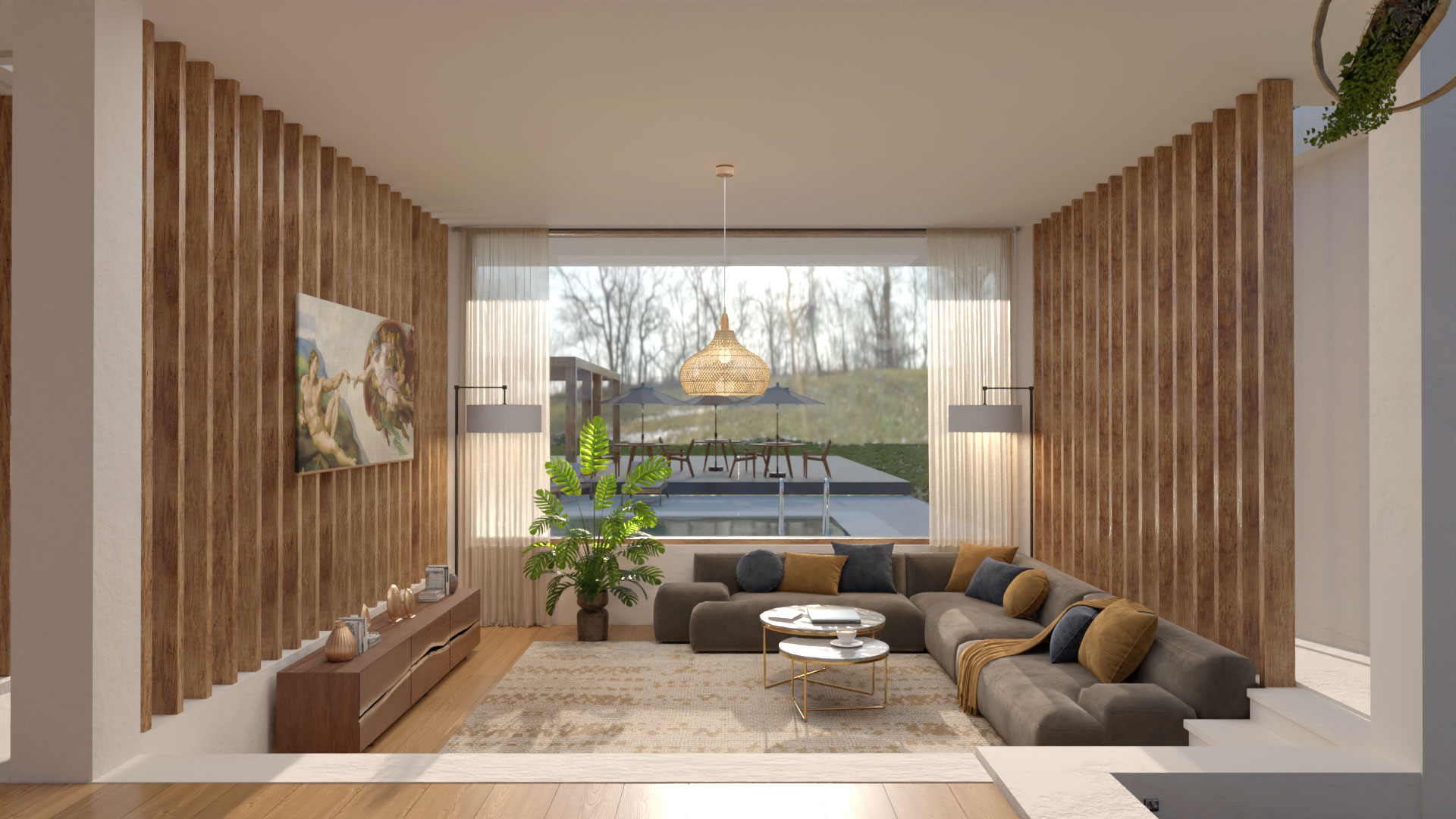
Can a home actively heal its inhabitants? This was the question that gave birth to Villa Sacra, a project integrating three disciplines: Vastu Shastra (India’s ancestral sacred architecture), neuroarchitecture (how space affects the brain), and biophilic design (reconnection with nature). This is not merely about aesthetics. It is about designing spaces that reduce cortisol, improve sleep, and allow your nervous system to breathe.
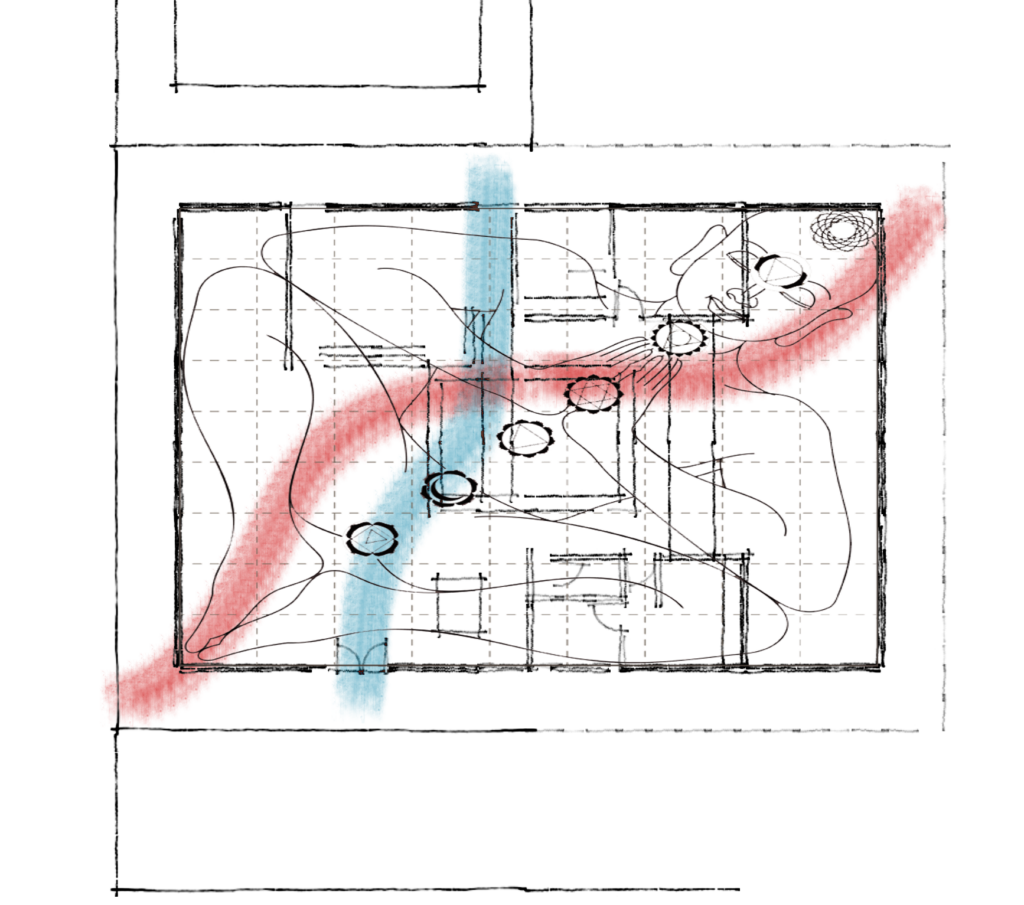
The Sacred Heart: The Central Courtyard
Before tracing a single wall, the process began by aligning the design with the Vastu Purusha Mandala, an ancestral cosmological map that organises a space’s energy according to natural and astronomical principles. The result: an almost-square floor plan with a central courtyard as the heart of the home. This is not a decorative courtyard; it is the sanctum sanctorum of the dwelling, the place where energy flows converge—entering and exiting like the breathing of a living organism. At its centre, a stone fire pit symbolises constant renewal. Natural stone, according to the study by Chevalier et al. (2012), improves sleep quality and reduces stress through grounding—direct contact with the earth’s electrons. Here, walking barefoot is not poetry: it is physiology.
The Double Skin: Privacy That Breathes
The private zone of Villa Sacra (bedrooms) incorporates a bioclimatic strategy that responds to the Mediterranean climate: a double façade with wooden latticework. How does it work?
Outer layer: Vertical shutters of treated local wood (movable)
Intermediate gallery: Buffer space that regulates temperature
Inner layer: Glass windows facing the rooms. This allows: Windows to remain open with shutters closed → natural ventilation + privacy.
Adjustable solar protection throughout the day, reduced thermal load without constant air conditioning
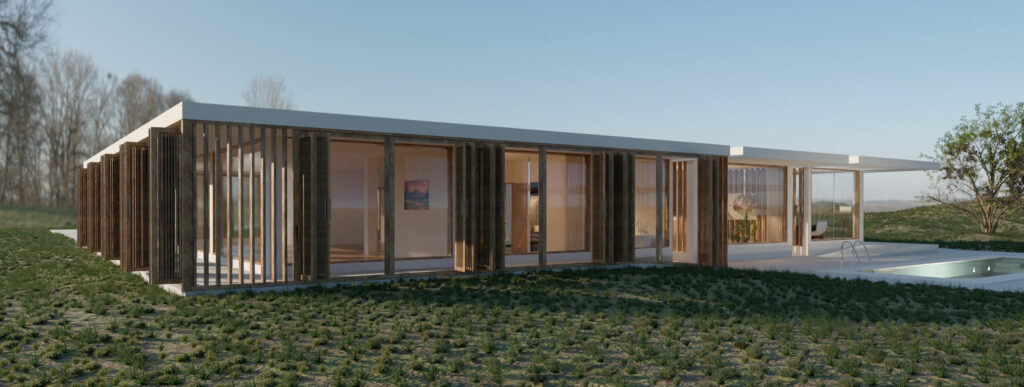
The study by Ikei et al. (2017) demonstrates that visual exposure to natural wood reduces stress and improves psychological wellbeing, activating the parasympathetic nervous system (the one responsible for relaxation). We did not choose wood simply because ‘it looks good’. We chose it because it calms the nervous system.
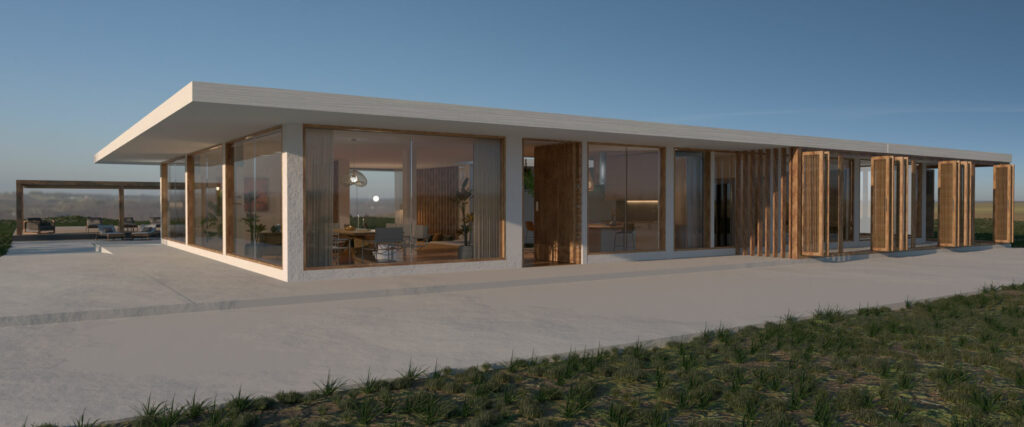
Transparency in Social Spaces, Refuge in Intimate Ones
While the private zone is protected by the double skin, the social zone (living room, dining room, study) opens completely to the landscape through biophilic glass with a coating that minimises heat transfer. This architectural duality is not arbitrary: it reflects how we truly inhabit a home.
Social zones: Total openness, visual connection with nature, abundant natural light
Rest zones: Controllable privacy, cross ventilation, welcoming refuge
Biophilic design is not simply about ‘adding plants’. It is about understanding that our brains evolved over millennia in direct contact with nature, and that sealed, synthetic spaces generate a subtle but constant friction in our nervous system.
Materials That Speak the Body’s Language
Every material in Villa Sacra was selected for its measurable benefits to human wellbeing:
Treated Local Wood The visible wood on façades, interior finishes, and furniture is not decoration. Research from Shimane University (Japan) demonstrates that visual and tactile exposure to natural wood significantly reduces cortisol levels—the stress hormone.
Linen, Jute, and Rattan Natural textiles offer more than aesthetic warmth. According to the Oeko-Tex Standard (2020), natural fibres such as linen and organic cotton do NOT release volatile organic compounds (VOCs), unlike polyester and acrylic, which continue to emit formaldehyde and phthalates for years. Breathing clean air in your home should not be a luxury.

Biophilic Glass The glass in social zones incorporates a special coating that minimises heat transfer, maintaining energy efficiency without sacrificing visual connection with the outdoors.
Lime-Based Paints Walls and ceilings use mineral-based lime paints that naturally regulate humidity and create a sense of refuge without hermetically sealing the space.
The Science Behind Wellbeing
This project is not based on intuition. It is based on peer-reviewed scientific research:
Stress reduction: Wood reduces cortisol (Sakuragawa et al., 2005).
Better sleep: Natural stone improves sleep quality (Chevalier et al., 2012).
Clean air: Natural textiles release no toxic VOCs (Oeko-Tex, 2020).
Thermal regulation: Stone with thermal mass reduces climate control load by up to 30% (Kumar et al., 2016).
When every design decision has a measurable ‘why’, the home ceases to be a passive container and becomes an active agent of wellbeing.
Does Your Home Recharge or Drain You?
Villa Sacra is an architectural manifesto: it is possible to design homes that do not merely shelter life, but amplify it. You do not need a complete villa to apply these principles. A diagnosis of your home’s vital axis (bedroom + living room) can reveal invisible energy blockages affecting your rest and vitality. Sometimes, exhaustion is not physical. It is spatial.
Do you want to discover what is blocking wellbeing in your home?→ Let’s talk about your space
Dra. Natalia Botero
Architect specialising in Vastu Shastra, Neuroarchitecture, and Biophilic Design.
www.espaciosparaser.com
References:
Sakuragawa et al. (2005) – Wood and cortisol reduction.
Ikei et al. (2017) – Wood and psychological wellbeing.
Chevalier et al. (2012) – Grounding and sleep quality.
Kumar et al. (2016) – Thermal mass in natural stone.
Oeko-Tex Standard (2020) – Natural vs. synthetic textiles.
